
Help Centre / Training and recovery articles
How to Train After a Physical Job Without Running Yourself Into the Ground
After a day of lifting, climbing, carrying or working overhead, another hour of exercise can be a hard sell. You still want to get stronger. You also need enough left to do your job tomorrow.
The useful question is how much training you can recover from alongside the work you already do. That will change between a quiet week, a run of overtime and the first few months in a new trade.
Here’s a sensible starting point for fitting the gym around a physical job.
Fit the gym around the working week
Look at the week ahead. If Friday usually runs late, don’t make Friday night your longest session. Put a workout on a day off or after a lighter shift when you can.
If you’re struggling to maintain four or five gym days, try two full-body sessions on non-consecutive days. Leave room to move them when work changes.
Australia’s current movement guidelines recommend muscle-strengthening activity on at least two days a week. That is a general health recommendation, not proof that two gym sessions are the ideal muscle-building programme for every tradie. It does show that a useful routine does not start with a six-day split. Australian Government guidelines.
A physical job can contribute to your activity and strength. But your tasks may repeat the same movements, and you don’t always control the load or rest breaks. In the gym, you can choose exercises and adjust them.
Use that flexibility. Start with a manageable schedule, then add training only when you’re handling it well.
Keep a couple of reps in reserve
You don’t need to grind through a failed rep at the end of every set.
In an eight-week study of 18 experienced lifters, training with one or two repetitions in reserve produced similar average quadriceps growth to training to failure. The failure condition caused greater immediate fatigue on the measures the researchers used. Refalo and colleagues, 2024.
A practical starting rule: finish most sets while you think you could still complete roughly two good reps. You should be working, but not pushing to absolute failure.
Estimating this takes practice. If you’re new to lifting, get help with technique and start conservatively rather than testing your limit.
Keep the session simple
For someone who already knows the movements, a short full-body session might include:
- A knee-dominant exercise, such as a squat variation or leg press.
- A hip-dominant exercise, such as a hip thrust or a hinge you can perform comfortably.
- An upper-body push, such as a push-up or dumbbell press.
- An upper-body pull, such as a cable row.
As a starting template, allow around 30–45 minutes, including your warm-up, and try two working sets per exercise. Choose a manageable rep range, such as 8–12, without chasing failure. These numbers are a practical suggestion. Your experience, goals and any injuries matter. Healthdirect recommends starting with light resistance, learning technique and building up gradually. Strength training guidance.
If an exercise causes pain, stop rather than trying to finish the set. A physiotherapist or accredited exercise physiologist can help adapt a programme around an ongoing problem.
Have a shorter version ready
Decide what a reduced session looks like before a rough day happens.
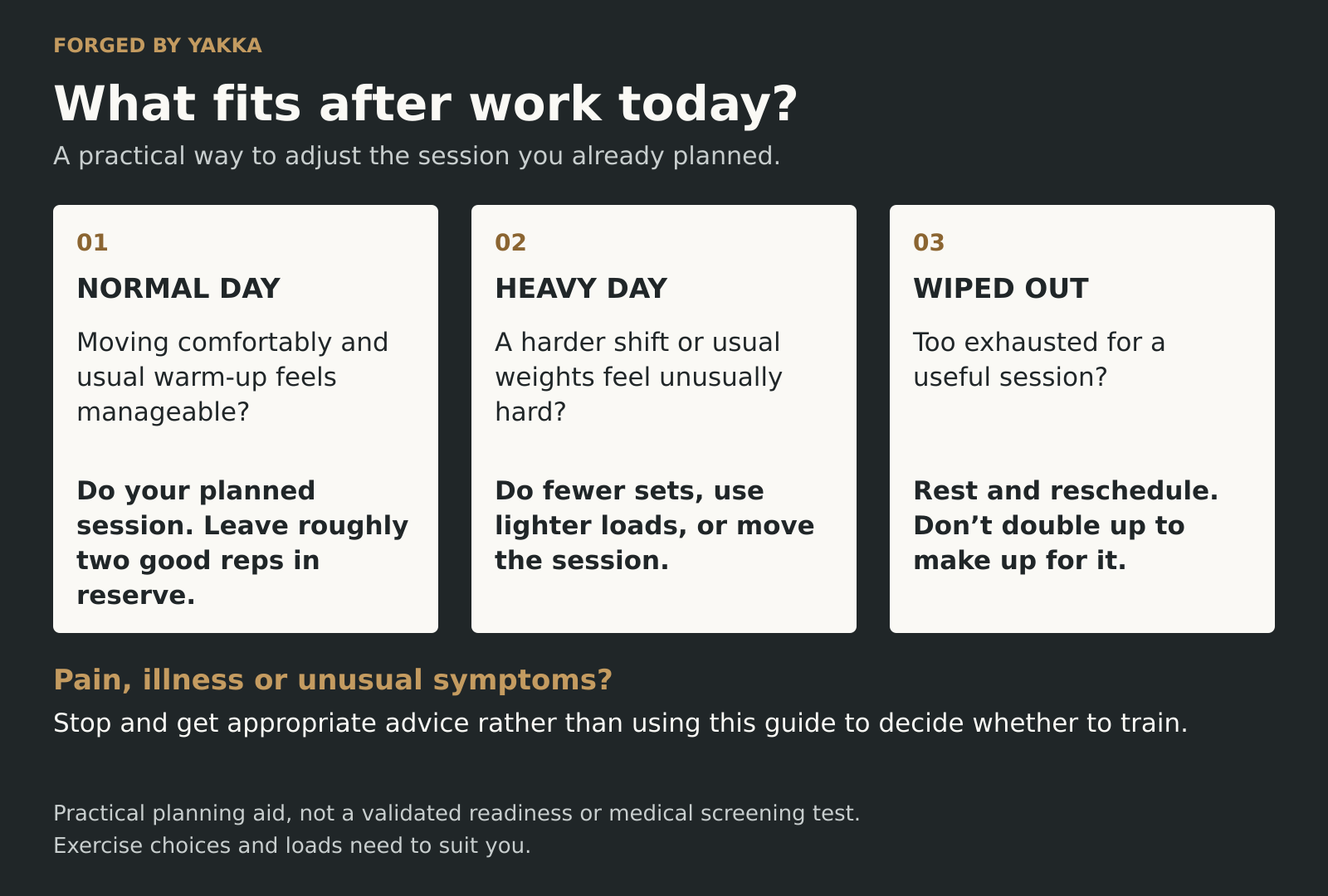
If the workday has been unusually demanding, you might do one working set per exercise instead of two, use lighter loads, or move the session. These are options for managing your week, not a test of commitment.
Use your warm-up to check how you’re moving. If an ordinarily easy load feels much harder, adjust the plan. Don’t turn that check into a maximum-effort lift.
Rest is also a valid choice when you’re wiped out. A missed Tuesday session does not need to become double the work on Wednesday.
Do not buy gym time with sleep
Training before work suits some people. Going straight from site suits others. Pick the option that fits your life without routinely cutting your sleep short.
Australian guidance recommends seven to nine hours of good-quality sleep for adults aged 18–64, with consistent bed and wake times. Australian Government guidelines.
If an early gym alarm means you keep getting five hours, look at a shorter session or a different day first.
Check the trend over a few weeks
Keep a simple note of your exercises, weights and reps, alongside whether work was light, normal or heavy. Look for gradual progress that you can sustain without feeling increasingly drained.
If performance keeps sliding, review the combined demands of work and training before adding more exercise.
Ongoing exhaustion deserves attention. Healthdirect recommends seeing your doctor if fatigue lasts more than two weeks without improving, or sooner if it worries you or interferes with everyday activities. Fatigue guidance.
Build a routine you can repeat through an ordinary working week. Once that is going well, you can decide whether you actually need more.
References
1. Australian Government Department of Health, Disability and Ageing. Recommendations for adults aged 18–64. Page updated 3 June 2026.
2. Refalo MC and colleagues (2024). Similar muscle hypertrophy following eight weeks of resistance training to momentary muscular failure or with repetitions-in-reserve in resistance-trained individuals. Journal of Sports Sciences, 42(1), 85–101. DOI: 10.1080/02640414.2024.2321021.
3. Healthdirect. Strength training for beginners. Reviewed May 2025.
4. Healthdirect. Fatigue. Reviewed August 2024.
General information only. Get individual advice from an appropriate health professional if you have an injury, health condition or concerns about exercising.